FACILITY AND ENERGY AUDIT
Facility and energy audit
Build a credible foundation for your behind-the-meter project
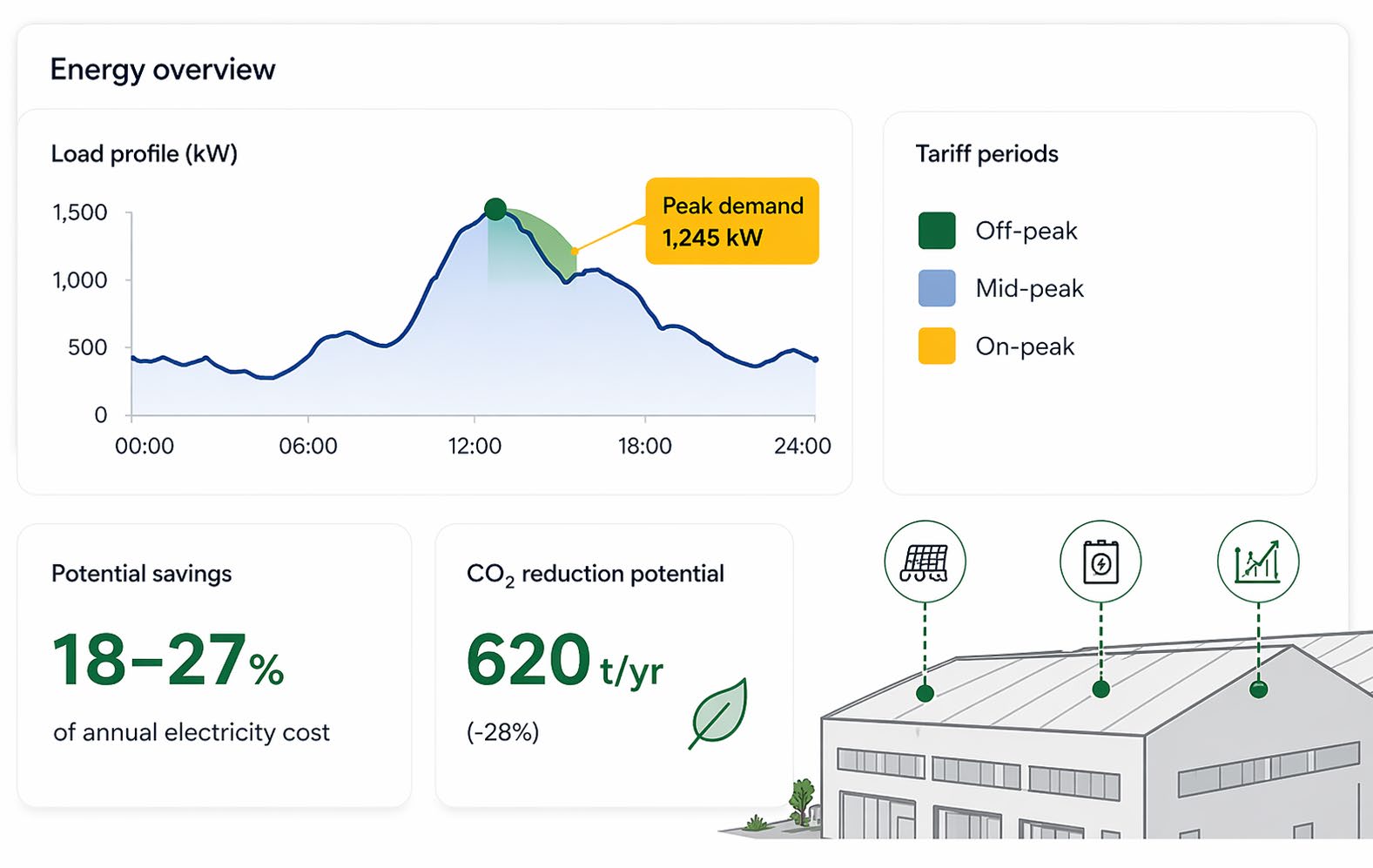
A facility and energy audit shows how your plant consumes electricity, where tariff costs arise, and which technical actions are worth considering first. We analyze consumption profiles, demand peaks, tariffs, infrastructure operation, and the potential for further PV, BESS, and EMS analysis.
The outcome is an organized energy baseline: data, findings, and recommended next steps for a behind-the-meter project. The audit does not replace a technical PV, BESS, or EMS design. Its purpose is to determine whether consumption profile, tariff costs, and site operating characteristics justify further analysis and solution design.
What is BESS?
BESS — Battery Energy Storage System — is a battery-based energy storage system comprising battery modules, power conversion equipment, and a control layer. In an industrial plant, BESS can work with PV and EMS to support self-consumption, limit the impact of short demand spikes, and enable more flexible behind-the-meter energy management — provided consumption profile and tariff conditions confirm it.
Scope of analysis
What does the audit cover?
Consumption profile analysis
We build an hourly picture of the site's energy demand: daily, weekly, and seasonal profiles, base and variable loads, and how consumption relates to the plant's operating schedule.
Tariffs, costs, and peaks
We check when energy costs the most and which elements of the operating profile may affect energy bills, distribution charges, contracted power, and use of tariff zones.
Anomalies and flexibility
We detect unusual energy behavior and assess whether there is room for better demand management.
Initial PV, BESS, and EMS analysis
We assess whether site data justifies further design of PV, BESS, or EMS. This is potential qualification, not a promise of a ready investment outcome.
Audit process
How does the facility and energy audit work?
In practice, we analyze
We start by collecting data on energy consumption, tariffs, costs, and the plant's operating profile. We then analyze hourly demand, identify peak consumption periods, and flag anomalies that may affect operating costs.
Based on this, we assess whether further design of solutions such as PV, BESS, and EMS is justified for the site. The audit delivers an organized energy baseline and recommended next steps — from identifying consumption profile optimization potential to an initial assessment of whether a behind-the-meter project makes sense.
- hour-by-hour electricity consumption profile,
- tariffs, demand peaks, and potential cost drivers,
- main energy and distribution cost components, including the impact of consumption profile, contracted power, and tariff zones,
- anomalies in site operation and opportunities to improve flexibility,
- potential for PV, BESS, and EMS,
- directions for further technical and business analysis.
Applications
Use cases in industry and production
A facility and energy audit is especially useful in plants where machine operating profiles, production variability, and tariff costs directly affect energy bills. The analysis helps identify where consumption is driven by the production process and where there is room for better demand management.
Multi-shift production and variable load
In plants running one, two, or three shifts, the audit helps explain how the production schedule affects energy demand profile, power peaks, and use of tariff zones.
High instantaneous power processes
The audit can point to equipment or processes that may cause short-term demand spikes. This is a starting point for assessing operational actions, EMS control, or BESS energy storage.
Sites with seasonal or irregular operating profiles
In facilities where demand changes between seasons, shifts, or production lines, the audit organizes data and helps identify periods of greatest cost pressure.
Sites planning PV, BESS, or EMS
For companies considering photovoltaics, energy storage, or an energy management system, the audit is the first step to assess whether such solutions match the site's actual consumption profile.
Plants preparing decarbonization projects
The audit can support planning actions that reduce grid energy use and structure a decarbonization path — without claiming outcomes before data analysis.
Business benefits
Business benefits
FAQ
Frequently asked questions
Have questions? Check the answers below or contact our expert.
What data is needed?
To start an audit, you typically need energy consumption data, invoices or a cost summary, information on tariff, contracted power, and plant operating profile — plus hourly meter or measurement system data if available. The better the data resolution, the more accurate the assessment of demand peaks, anomalies, and PV, BESS, and EMS potential.
What you receive
- a map of the site's electricity consumption,
- analysis of hourly demand and operating profile,
- identification of tariff costs, peaks, and anomalies,
- assessment of energy flexibility potential,
- initial analysis of whether further PV, BESS, and EMS work is justified,
- recommended next steps for a behind-the-meter project.
Optimize energy costs today
Request an offer and our expert will get back to you within 24 hours with a tailored proposal.
What you get
- Initial cost review with no obligation
- Solution tailored to your business needs
- Response within one business day
- Technical support and expert consultation
- End-to-end delivery — from design to service