Article in 45 seconds
- EMS systems integrated with PV and BESS deliver 20–35% annual energy cost savings in Polish production plants, with ROI of 2–4 years.
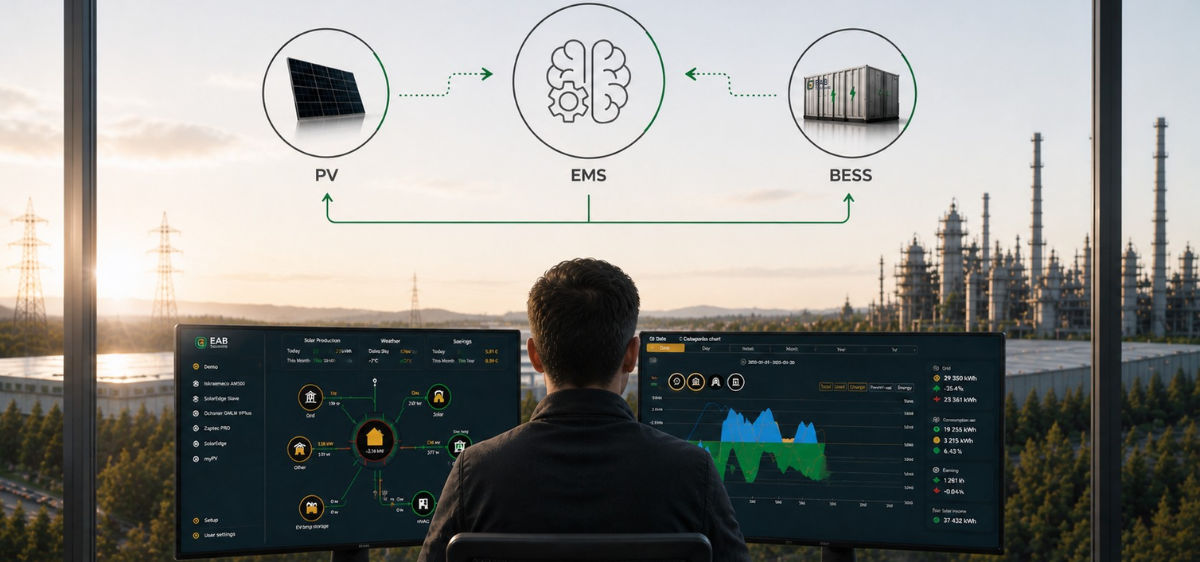
- The key to success is integrating three elements: PV (generation), BESS (buffer), and EMS (the “brain”).
- The best results are achieved by plants with a high and stable load profile operating in multi-shift mode.
- Deployments co-financed by KPO and NFOŚiGW shorten ROI to 1.5–2.5 years.
- EAB Solutions has delivered deployments in food processing, chemicals, metallurgy and logistics.
Table of contents:
- Why are production plants increasingly investing in EMS and PV?
- Case study #1: Food plant – B23 tariff optimization and peak shaving
- Case study #2: Packaging manufacturer – PV + BESS + EMS with KPO co-financing
- Case study #3: Industrial cold store – managing flexible loads
- Case study #4: Metallurgy plant – contracted power reduction and self-consumption
- Common lessons – what works and what doesn’t?
- What does a typical EMS + PV project look like in a plant?
- FAQ – frequently asked questions
Why are production plants increasingly investing in EMS and PV?
After the sharp increase in energy costs in 2021–2024 (a 40–70% rise for a typical industrial consumer, according to Eurostat), Polish production plants stopped treating electricity prices as a fixed cost. The market has stabilized, but the risk of further increases remains real — and this risk is driving investment decisions in EMS, PV and BESS.
Investments in energy management systems and photovoltaics have become a purely economic decision. Plants that implemented comprehensive systems before 2024 have observed ROI that was initially estimated at 6–8 years, but in reality closed in 2–3 years. Protection against price volatility turned out to be the most valuable “side effect” in practice.
Market context: According to URE data, total installed PV capacity in Poland exceeded 20 GW by the end of 2024 (all segments). The commercial and industrial segment (>1 MW) is growing dynamically. At the same time, the EMS market for industry is growing at around 25% annually, indicating accelerating adoption. Current data: ure.gov.pl
Below we present four anonymized case studies delivered by EAB Solutions, illustrating different scenarios and outcomes of EMS and PV investments in Polish industry.
Case study #1: Food plant – B23 tariff optimization and peak shaving
Site profile
| Industry | Food processing (continuous production, 3 shifts) |
|---|---|
| Location | Greater Poland Voivodeship |
| Contracted power (before) | 700 kW |
| Annual electricity consumption | 3.2 GWh |
| Distribution tariff | B23 |
| Solutions implemented | BESS 500 kWh + EMS + PV 300 kWp |
Problem
The plant struggled with systematic exceedances of contracted power (6–8 events per year) and high contracted power charges resulting from a non-optimized load profile. Continuous production made it impossible to shift processes to night hours. Annual penalties amounted to PLN 65–90k.
Implementation
In the first phase, an EMS was installed with integration of the AMI meter and process sub-metering. The system collected 6 weeks of historical data and identified three recurring peak patterns: line restart after breakfast break (around 7:30), full line start after lunch break (around 13:00), and an evening peak associated with the night shift change (around 21:30).
Based on this, a BESS with 500 kWh usable capacity and 200 kW power was selected. The BESS discharges 2 minutes ahead of the forecasted peak, reducing grid draw by 150–180 kW at critical moments. A 300 kWp PV system covers 25–30% of daytime consumption.
Results after 12 months
| Contracted power reduction | 700 → 550 kW (−21%) |
|---|---|
| Number of exceedance penalties | 7 → 0 (fully eliminated) |
| Peak shaving savings | PLN 138k/year |
| PV self-consumption savings | PLN 82k/year |
| Total savings | PLN 220k/year |
| Project CAPEX | PLN 810k (no co-financing) |
| Simple payback | 3.7 years |
Lesson learned
Without EMS, the plant would have paid another PLN 65–90k in penalties in the first year after implementation. Key insight: the EMS prediction algorithm achieved 94% peak anticipation accuracy versus the assumed 85%, thanks to the regularity of daily production cycles in food plants — an ideal environment for machine-learning-based forecasting.
If your plant has a similar profile, contact us for a free BESS + EMS analysis and quote: info@eabsolutions.com.pl
Case study #2: Packaging manufacturer – PV + BESS + EMS with KPO co-financing
Site profile
| Industry | Plastic packaging manufacturing |
|---|---|
| Location | Silesian Voivodeship |
| Contracted power | 400 kW |
| Annual electricity consumption | 1.8 GWh |
| Distribution tariff | B23 |
| Solutions implemented | PV 500 kWp + BESS 250 kWh + EMS |
| Co-financing | KPO A2.1.1 – 55% CAPEX (SME; intensity depends on category and location) |
Problem
The plant had large roof areas (production halls) almost ideally oriented to the south. The owner considered PV alone, but analysis showed that without BESS and EMS, self-consumption given the production profile would be only 40–45% of generated energy. The rest would be exported to the grid at a low buyback price.
Implementation
The project included a 500 kWp rooftop PV system, a 250 kWh BESS buffer for solar surplus, and an EMS managing prioritization: direct PV self-consumption → charge BESS from PV → discharge BESS during power peaks → export remaining surplus to the grid.
KPO application documentation included an energy audit under EN ISO 50002, a feasibility study with a 15-year techno-economic model, and a technical design. Co-financing covered 55% of eligible costs.
Results after 12 months
| PV self-consumption | 78% (vs. 42% without BESS and EMS) |
|---|---|
| Reduction in grid energy purchases | −31% |
| Energy cost savings | PLN 165k/year |
| CO2 reduction | 285 t CO2/year |
| Gross CAPEX | PLN 1,150k |
| KPO co-financing | PLN 632k |
| Net CAPEX (after co-financing) | PLN 518k |
| Simple payback (after co-financing) | 3.1 years |
Lesson learned
KPO funding turned this project from profitable to exceptionally profitable — PLN 632k of support against PLN 518k net investment. Key process insight: documentation took 8 weeks and the application assessment took 4 months. Patience in the funding process delivered a return equal to the entire net CAPEX.
Case study #3: Industrial cold store – managing flexible loads
Site profile
| Industry | Cold storage and refrigerated logistics |
|---|---|
| Location | Masovian Voivodeship |
| Contracted power | 1,200 kW |
| Annual electricity consumption | 5.8 GWh |
| Distribution tariff | B23 |
| Solutions implemented | EMS integrated with the cold store BMS + BESS 500 kWh |
Challenge specifics
Industrial cold stores have a unique energy profile. High thermal inertia of chambers enables flexible compressor management. Temperature changes slowly, giving EMS a 15–30 minute window for pre-cooling or temporarily switching off compressors without risking a technology temperature breach.
Implementation
The EMS was integrated with the Building Management System (BMS), providing access to temperature telemetry from 47 cold and freezer chambers. The prediction algorithm schedules pre-cooling to hours with lower energy prices (night valley or periods of high renewable supply) and deactivates some compressors during peak demand hours.
A 500 kWh BESS plays a complementary role — it covers short peaks caused by simultaneous start-up of multiple compressors (in-rush current), which cannot be fully eliminated by process control alone.
Results after 12 months
| Peak power reduction | −18% (from 1,200 to ~985 kW effective) |
|---|---|
| Contracted power renegotiation | 1,200 → 1,000 kW (−17%) |
| Savings from contracted power | PLN 95k/year |
| Savings from load management | PLN 78k/year |
| Total savings | PLN 173k/year |
| EMS + integration cost | PLN 320k |
| Simple payback | 1.85 years |
Lesson learned
This deployment debunks the myth that investing in EMS without PV is not worth it. The cold store had no suitable roof for PV — yet achieved ROI under 2 years solely through EMS integrated with BMS. Thermal flexibility is one of the most valuable energy assets many cold-store owners simply don’t realize they have. EMS should be the first, not the last step in an energy optimization strategy.
Case study #4: Metallurgy plant – contracted power reduction and self-consumption
Site profile
| Industry | Foundry and metal processing |
|---|---|
| Location | Lower Silesian Voivodeship |
| Contracted power | 2,500 kW |
| Annual electricity consumption | 11 GWh |
| Distribution tariff | B23 (supply from GPO – own MV/MV substation) |
| Solutions implemented | EMS + PV 800 kWp + BESS 1,000 kWh with FFR mode |
| Co-financing | NFOŚiGW programme – energy efficiency in enterprises (40% CAPEX; programme name anonymized) |
Problem
The plant has a strongly impulsive load profile. Induction and arc furnaces generate short (5–30 second) power peaks up to 3,500 kW — 40% above contracted power. A standard BESS responds in 100–500 ms, too slow to catch the impulse before it is included in the 15-minute billing window.
Implementation
The deployment required a specialized BESS configuration with a dedicated Power Conditioning System (PCS) in Fast Frequency Response (FFR) mode, enabling reaction below 20 ms. Without PCS FFR, a standard containerized LFP system reacts in 100–500 ms, which would be insufficient for arc furnace impulses. The EMS monitors voltage and current on busbars at 100 Hz, providing a real-time trigger signal for PCS.
An 800 kWp PV installation on hardened areas (parking and yards) covers about 15–18% of daytime consumption in summer — relatively little against an 11 GWh profile, but still meaningful at high energy prices.
Results after 12 months
| Elimination of impulsive exceedances | 100% (0 events vs. 80–100/year previously) |
|---|---|
| Contracted power renegotiation | 2,500 → 2,100 kW (−16%) |
| Savings from exceedance penalties | PLN 240k/year |
| Savings from contracted power | PLN 185k/year |
| PV savings | PLN 130k/year |
| Total savings | PLN 555k/year |
| Gross CAPEX | PLN 2,800k |
| NFOŚiGW co-financing | PLN 1,120k |
| Simple payback (after co-financing) | 3.0 years |
Common lessons – what works and what doesn’t?
| What works | What doesn’t deliver expected results |
|---|---|
| EMS as the first investment – data collection and potential identification | PV alone without EMS and BESS – low self-consumption |
| Peak shaving with BESS + EMS prediction – elimination of exceedance penalties | BESS without EMS integration – reactive, not proactive |
| Contracted power renegotiation after 6 months of EMS data | Tariff change without full bill analysis |
| KPO/NFOŚiGW co-financing – ROI shortened by 30–50% | Waiting for the “perfect moment” – every year without optimization is a loss |
| Integration with BMS/SCADA – full energy context | Monitoring without optimization algorithms – data without action |
What does a typical EMS + PV project look like in a plant?
Based on completed deployments, a typical project follows this schedule:
| Stage | Scope | Duration |
|---|---|---|
| 1. Audit and analysis | Collect historical data, analyze bills, identify potential | 2–3 weeks |
| 2. Technical design | Select BESS power and capacity, PV layout, EMS integration scheme | 3–4 weeks |
| 3. Co-financing application | Feasibility study, KPO/NFOŚiGW documentation | 6–10 weeks |
| 4. BESS delivery and installation | Transport, foundation, connection | 2–3 days |
| 5. PV installation | Modules, inverters, cabling | 2–4 weeks |
| 6. EMS integration | Configuration, algorithms, testing, commissioning | 1–2 weeks |
| 7. Monitoring and optimization | Ongoing analytical supervision, algorithm updates | Continuous |
Total time from decision to full system go-live is usually 3–6 months (excluding waiting time for co-financing) or 9–14 months when delivered with KPO.
FAQ – frequently asked questions
Yes — and it is recommended as a first step. EMS integrated with meters and SCADA brings measurable benefits: identifying waste, optimizing process schedules, and eliminating exceedance penalties through better load control. The cost of EMS alone is much lower than a full project with BESS and PV, and payback is fast — as in the cold-store case (1.85-year ROI without PV).
Based on EAB Solutions experience, the profitability threshold for a full EMS + BESS system is around 200 kW contracted power and annual consumption above 500 MWh. Below that, PV with EMS can be profitable, but an energy storage system will have too long a payback without co-financing.
EAB Solutions EMS stores data in the cloud on servers located in Poland (ISO 27001-compliant data center). Access is encrypted (TLS 1.3), and the plant remains the sole owner of its data. On request, an on-premise setup without external data transmission is possible.
EAB Solutions BESS systems include a 5-year capacity warranty (min. 80% at 5 years) and a 10-year factory warranty for defects. Service includes 24/7 remote monitoring, EMS software updates and annual inspections. On-site response time: up to 24 hours on business days.
An EN ISO 50002 energy audit is required for most co-financing programmes (KPO, NFOŚiGW). Regardless of co-financing, the audit is also a key tool for selecting the optimal system configuration — it helps avoid over- or under-sizing BESS. EAB Solutions provides the energy audit as part of the free initial analysis.
See how much your production plant can save
Free energy analysis in 48h — we estimate real savings potential from EMS, PV and BESS based on your data.
Selection of the optimal co-financing path (KPO, NFOŚiGW, FEDS) and preparation of application documentation.
→ info@eabsolutions.com.pl | ul. Domaniewska 44, 02-672 Warsaw
See also

Why Monitoring Is Not Enough – How Intelligent Energy Management (EMS) Differs from Classic Measurement Systems
Visualizing energy consumption alone won't lower bills. Classic monitoring shows how much and when you consume energy. Intelligent Energy Management System (EMS) goes a step further: it forecasts, decides and controls devices in real-time.

Why energy monitoring is no longer enough in a production plant
Monitoring consumption is a good starting point, but in the reality of industry it is far from sufficient. An intelligent EMS will stop costs that a consumption chart alone will not.

Energy Prediction in Industry – How Algorithms Predict Peaks and Energy Prices
Rising energy costs, tariff sensitivity, and the growing role of renewables mean industrial plants must act faster, more precisely, and more consciously. Energy prediction enables cost reduction, production stabilization, and limiting the impact of price fluctuations.